|
There are a
number of companies that offer small hydropower
systems. They usually offer system design help
to determine your hydropower potential. As I get
the time, I'll list some of them on this site.
If you have recommendations I'd like to hear
them.
Note:
Water height is
more important than water volume; it is easier
and less expensive to convert water under high
pressure (from height) into useable
energy.
It makes huge
economic sense to size power systems to meet
your average needs and provide a means to store
excess power for times when you need more power
than your system is designed to handle. It costs
about ten times less to design a power system
this way. AND in most cases this is the way that
the power system would need to be designed
anyway, because most water supplies are low flow
or low drop and simply could not provide enough
water to make an instaintanious demand of, let's
say 20 KW.
Hydropower can
simply store water in a reservoir behind a dam
for use as desired. Usually wind and solar are
best advised to store their power in batteries,
but there are times when batteries are not the
best or only solution.
Example, using a
windmill water pump to pump water up into a
reservoir, which then drains down through a
water turbine as the power is required. In
addition to not having to maintain a battery
bank, the reservoir can be useful for a fresh
water supply, raising fish, a thermal heat
storage, etc.
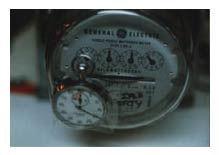 Another
way to store excess hydropower is to use the
'Reverse your Electric Meter' technology. Assume
for example that you get times of the year that
you have a lot of water flowing and no practical
way to build a large reservoir or battery bank.
You can 'store' your excess power in your local
utilities power grid by turning your electric
meter backwards. An arrangement with your
utility will allow you to use your stored credit
at a later time when your water flow slows
down. Another
way to store excess hydropower is to use the
'Reverse your Electric Meter' technology. Assume
for example that you get times of the year that
you have a lot of water flowing and no practical
way to build a large reservoir or battery bank.
You can 'store' your excess power in your local
utilities power grid by turning your electric
meter backwards. An arrangement with your
utility will allow you to use your stored credit
at a later time when your water flow slows
down.
|